

A utility balcony is one of the most frequently used spaces in a home, yet it is often overlooked during interior planning. From washing clothes and drying laundry to storing cleaning supplies, this compact area supports several everyday household activities.
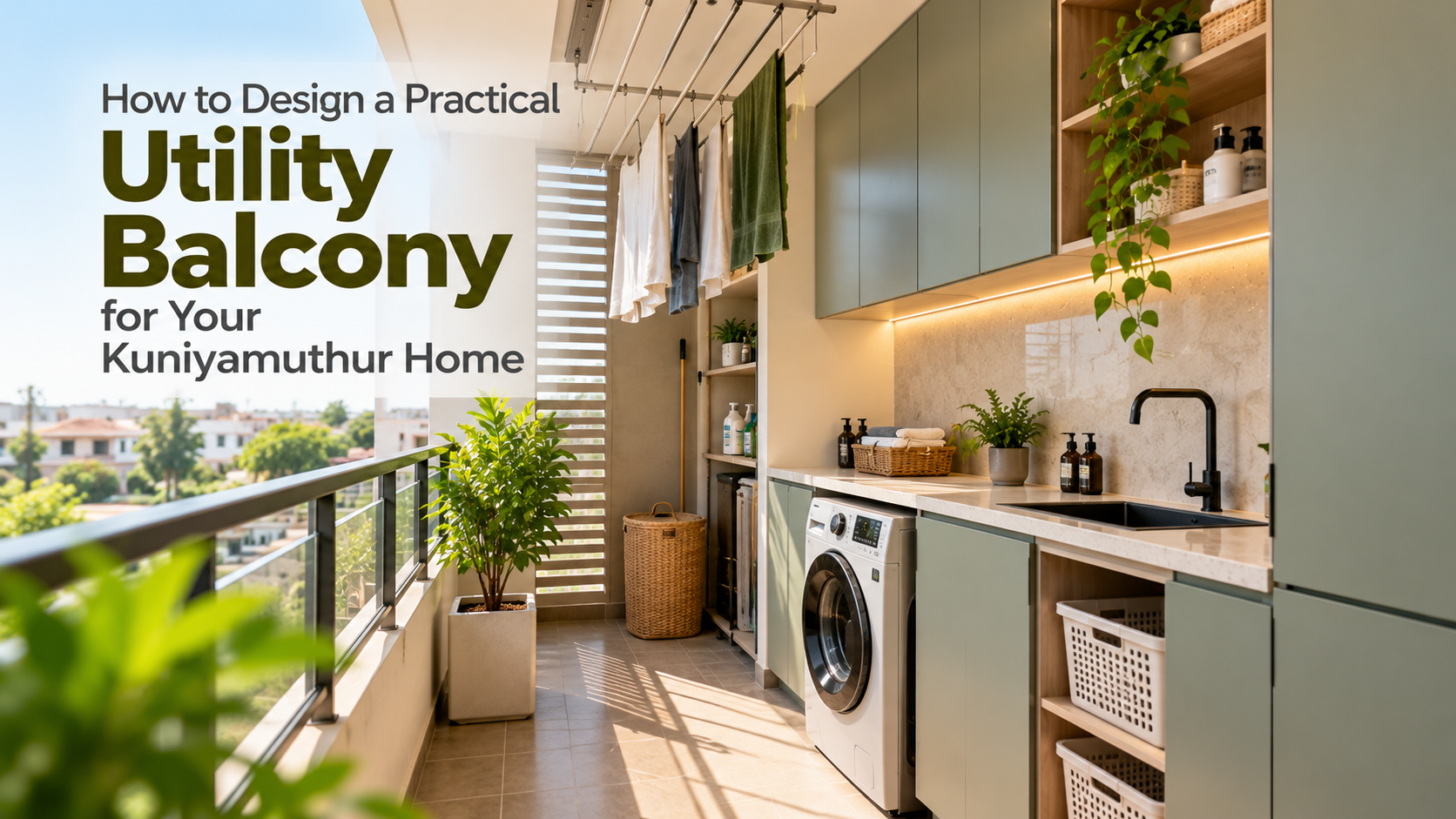
A utility balcony is one of the most frequently used spaces in a home, yet it is often overlooked during interior planning. From washing clothes and drying laundry to storing cleaning supplies, this compact area supports several everyday household activities.
In many independent houses and apartments in Kuniyamuthur, homeowners prefer to keep laundry activities separate from the kitchen, bedrooms and living areas. However, limited balcony space can make it challenging to accommodate a washing machine, clothes-drying rack and storage cabinets without creating clutter.
A well-planned utility balcony can make everyday laundry tasks more convenient while maintaining proper ventilation, drainage and comfortable movement.
Homeowners exploring customised solutions with interior designers in Kuniyamuthur can consider space-saving utility cabinets, practical washing machine arrangements and organised laundry storage based on their available space.
This guide explains how to design a functional utility balcony that accommodates washing, drying and storage without compromising convenience.
Before selecting cabinets or installing a washing machine, identify the activities that will take place in the utility balcony.
Different households have different laundry requirements.
Some families may use the space primarily for washing and drying clothes. Others may also need storage for cleaning equipment, buckets, detergents and household maintenance items.
Common utility balcony activities include:
Washing clothes using a washing machine.
Handwashing delicate garments.
Drying everyday laundry.
Storing detergents and fabric care products.
Keeping cleaning tools organised.
Sorting clothes before washing.
Temporarily storing laundry baskets.
Understanding these requirements helps determine the most suitable layout.
For example, a household that regularly handwashes clothes may require a utility sink, while another household may prioritise a larger clothes-drying area.
The design should reflect actual daily activities rather than simply filling the available space with cabinets.
Accurate measurements are essential when planning a compact utility area.
Before selecting furniture or appliances, measure the balcony's length, width and usable height.
Also identify the positions of existing plumbing connections, drainage outlets, electrical points and windows.
Consider the clearance required for:
Opening the washing machine door.
Accessing storage cabinets.
Moving laundry baskets.
Using a utility sink.
Walking through the balcony.
Operating clothes-drying racks.
If the utility balcony is particularly narrow, large floor-standing cabinets may reduce movement space.
In such cases, wall-mounted storage or compact shelving may be more suitable.
A practical layout should allow household members to complete laundry activities without constantly moving objects out of the way.
The washing machine is usually the largest appliance in a utility balcony.
Its location should therefore be finalised before planning surrounding storage.
Ideally, the machine should be positioned close to suitable water supply, drainage and electrical connections.
However, homeowners should also consider the manufacturer's installation requirements.
Important factors include:
Adequate ventilation around the appliance.
Suitable floor support.
Access to water connections.
Proper wastewater drainage.
Sufficient clearance for maintenance.
Protection from excessive rain and direct weather exposure.
The machine should stand on a stable, level surface.
Avoid positioning it where the door cannot open fully or where nearby cabinets obstruct access.
The final arrangement should also allow convenient loading and unloading of clothes.
The type of washing machine affects the utility balcony's furniture arrangement.
A front-load machine requires sufficient space in front of the appliance for opening its door and handling laundry.
Depending on the manufacturer's specifications, a suitable counter may sometimes be installed above it.
This can provide additional surface space for sorting or folding clothes.
However, the counter must not interfere with ventilation, maintenance or appliance movement.
A top-load machine requires clear space above the appliance to open its lid.
Installing a fixed counter immediately above it may make the machine difficult or impossible to use.
For this arrangement, storage can be planned along an adjacent wall or above the machine at an appropriate height.
The choice of cabinetry should be based on the appliance's dimensions and operating requirements.
A utility balcony must have suitable plumbing arrangements for washing activities.
Poor drainage can result in water accumulation, unpleasant odours and maintenance problems.
Before installing a washing machine or utility sink, check whether the existing plumbing can support the intended arrangement.
Important considerations include:
Reliable water supply.
Suitable wastewater discharge.
Properly connected drainage pipes.
Accessible plumbing fittings.
Adequate floor drainage where required.
Protection against leaks.
Washing machine wastewater should be discharged through an appropriate plumbing connection rather than allowed to flow freely across the balcony floor.
If plumbing changes are required, they should be assessed and completed by qualified professionals.
In apartments, homeowners should also check building rules before altering existing drainage connections.
Wall-mounted cabinets can help organise laundry supplies without occupying valuable floor space.
These cabinets may be used to store items such as:
Detergents.
Fabric conditioners.
Laundry accessories.
Cleaning cloths.
Spare brushes.
Household cleaning products.
Cabinet dimensions should be based on the available wall space and the items being stored.
Avoid installing cabinets so low that they interfere with washing machine access or daily movement.
Similarly, cabinets positioned too high may be inconvenient to use.
Frequently used items should remain within comfortable reach.
Cabinets must be securely fixed to suitable wall structures using appropriate installation methods.
Utility balconies may experience humidity, water splashes and changing weather conditions.
Materials that perform well in dry indoor rooms may not always be suitable for exposed utility spaces.
Before selecting cabinetry, consider the balcony's level of weather exposure.
Suitable material choices depend on the specific application and may include properly specified moisture-resistant boards, treated metal systems or other products intended for humid environments.
Homeowners should pay attention to:
Resistance to moisture.
Edge sealing.
Hardware quality.
Corrosion resistance.
Cleaning requirements.
Suitability for the level of exposure.
Even moisture-resistant materials may deteriorate if they are continuously exposed to standing water or direct rainfall.
The design should therefore combine suitable materials with effective weather protection and drainage.
A ceiling-mounted drying rack can help make better use of vertical space.
This arrangement may be useful in compact utility balconies where floor-standing drying stands occupy too much space.
Depending on the system, the rack may be lowered for hanging clothes and raised when not in use.
However, the installation must be suitable for the ceiling structure and the expected weight of wet laundry.
Before selecting a system, consider:
Available ceiling height.
Safe load capacity.
Ease of operation.
Clearance from windows and doors.
Accessibility for household members.
Ventilation around hanging clothes.
Ceiling-mounted racks should not obstruct ceiling fans, electrical fixtures or essential access routes.
Professional installation is important to ensure that the rack is securely supported.
A foldable wall-mounted drying rack offers another space-saving option.
It can provide temporary drying space and fold away when not required.
This may be particularly useful in narrow utility balconies.
However, the rack should be installed at a height that is comfortable for the intended users.
The supporting wall and fixings must also be suitable for the weight of wet clothes.
Avoid installing a foldable rack where it blocks access to the washing machine or utility sink.
The ideal position should allow laundry to dry without interfering with other household activities.
Ventilation is an important factor in utility balcony design.
Wet clothes release moisture into the surrounding air.
Without sufficient airflow, drying may take longer and humidity can accumulate.
Where possible, the drying area should benefit from natural ventilation.
Homeowners should avoid enclosing the entire balcony with airtight cabinetry or partitions.
If the utility area is partially enclosed, the ventilation arrangement should be evaluated carefully.
The objective is to allow moisture to escape while protecting appliances and stored items from excessive weather exposure.
Clothes should also be spaced appropriately on drying racks to support airflow.
A well-ventilated utility balcony can make daily laundry activities more convenient.
A small counter can provide a convenient surface for folding clothes after drying.
However, it should not reduce the balcony's usable movement space.
For some front-load washing machine arrangements, a suitable counter above the appliance may be considered, subject to appliance clearance and installation requirements.
In other layouts, a foldable wall-mounted counter may be more practical.
The counter should be positioned at a comfortable working height.
Its surface should also be easy to clean.
Homeowners should avoid making the folding counter unnecessarily large.
A compact surface that supports everyday laundry tasks may be sufficient.
A utility sink can be useful for handwashing delicate clothes, rinsing cleaning equipment or handling other household tasks.
However, it should only be included when sufficient space and suitable plumbing are available.
A large sink may occupy valuable space in a narrow balcony.
A compact sink may be more appropriate for smaller utility areas.
Before installation, consider:
Sink dimensions.
Water supply.
Drainage requirements.
Countertop space.
Comfortable access.
Splash protection.
The sink should not interfere with washing machine operation or cabinet access.
For some households, a utility sink may be essential. For others, the existing bathroom or kitchen washing facilities may be sufficient.
Brooms, mops, brushes and other cleaning tools can make a utility balcony appear cluttered when stored without a proper arrangement.
A dedicated storage section can help keep these items organised.
Possible solutions include:
Wall-mounted hooks.
Vertical tool holders.
Narrow storage cabinets.
Compact shelves.
Suitable hanging organisers.
Long-handled cleaning tools should be stored securely so that they do not fall or obstruct movement.
Wet mops and cleaning equipment should be allowed to dry appropriately before being stored in enclosed cabinets.
This helps maintain cleanliness and reduces unnecessary moisture accumulation.
Laundry baskets are useful for collecting, sorting and transporting clothes.
However, large baskets can occupy valuable floor space in a compact utility balcony.
Consider selecting baskets that fit beneath a suitable counter or within a designated storage area.
For households that separate laundry by colour or fabric type, multiple smaller baskets may be more convenient than one oversized container.
The baskets should be easy to remove and clean.
Avoid placing them directly in front of the washing machine door or along narrow walkways.
A designated laundry basket location can make the utility area easier to maintain.
Vertical storage can help maximise the utility of a compact balcony.
However, installing cabinets and shelves across every available wall may make the area feel cramped.
Instead, identify the most useful storage zones.
For example, frequently used laundry products may be stored in a cabinet near the washing machine.
Cleaning tools may be organised along a separate wall.
Clothes-drying systems can occupy another suitable section.
This arrangement helps prevent different activities from interfering with one another.
The objective is to use available height efficiently while maintaining comfortable access and ventilation.
Utility balcony flooring should be appropriate for an area where water may occasionally be present.
A slippery floor can create safety risks, particularly when carrying laundry baskets.
When selecting or renovating flooring, consider:
Slip resistance.
Ease of cleaning.
Water exposure.
Drainage requirements.
Durability.
Compatibility with existing waterproofing.
Outdoor-appropriate, slip-resistant tiles may be suitable for some utility balcony arrangements.
However, the flooring should be selected according to the balcony's exposure and construction.
If flooring modifications are planned, existing waterproofing and drainage details should be assessed before work begins.
Washing machines require suitable electrical connections.
In some utility balconies, homeowners may also require lighting or other electrical facilities.
Electrical points should be positioned according to applicable safety standards and appliance manufacturer requirements.
They should not be exposed to direct water splashes or located where water may accumulate.
Avoid relying on loose extension cords for permanent appliance connections.
Electrical installation should be completed by a qualified electrician.
Suitable protection, earthing and circuit arrangements should be assessed for the specific installation.
Safety should take priority over convenience when planning electrical points in a potentially wet area.
Some utility balconies in Kuniyamuthur may be partially exposed to outdoor weather.
Rainwater, direct sunlight and dust can affect appliances, cabinets and stored household items.
The level of protection required depends on the balcony's orientation and existing construction.
Homeowners may consider suitable weather-protection measures where permitted.
However, any enclosure should preserve necessary ventilation, drainage and safe access.
Apartment residents should check building regulations and association requirements before making changes to the balcony structure or external appearance.
Weather protection should not create an enclosed, poorly ventilated space.
A utility balcony should be designed for regular maintenance.
Open floor areas, accessible drainage points and easy-to-clean surfaces can make housekeeping more convenient.
Avoid creating narrow gaps behind cabinets where dirt and moisture may accumulate.
Storage units should not permanently block plumbing connections that may require inspection or repair.
Where possible, keep cleaning products organised and avoid storing unnecessary items.
A simple layout with clearly defined washing, drying and storage areas is often easier to maintain than a heavily furnished utility balcony.
The utility balcony should be convenient for the people who use it regularly.
For elderly family members, high overhead drying racks may be difficult to operate.
Similarly, deep cabinets or heavy pull-out storage systems may not be suitable for everyone.
Consider:
Comfortable working heights.
Easy-to-reach storage.
Stable walking surfaces.
Accessible washing machine controls.
Suitable lighting.
Unobstructed movement.
Frequently used items should be stored at practical heights.
If the balcony is used by multiple family members, the design should accommodate their different needs.
A functional utility area should support everyday routines without unnecessary physical strain.
Even a small utility balcony can function efficiently when important planning mistakes are avoided.
Installing oversized cabinets: Large cabinets can reduce movement space and make the balcony difficult to use.
Ignoring washing machine clearance: Appliance doors and maintenance access should remain unobstructed.
Poor drainage planning: Inadequate wastewater disposal can lead to water accumulation.
Using unsuitable cabinet materials: Materials should be selected according to moisture and weather exposure.
Overloading drying racks: Drying systems must be installed and used within their rated capacity.
Blocking natural ventilation: Poor airflow can increase humidity and slow clothes drying.
Placing electrical points near water: Electrical safety requirements should be addressed during planning.
Adding too many storage shelves: Excessive storage can make the balcony feel crowded.
Ignoring floor safety: Suitable flooring and drainage help reduce slipping risks.
Overlooking cleaning access: Plumbing, drainage and appliance connections should remain accessible.
Avoiding these mistakes can help create a utility balcony that is practical, organised and easier to maintain.
A well-designed utility balcony requires careful coordination between appliance placement, storage requirements, ventilation and available space.
Rather than treating the balcony as an area for leftover household items, homeowners can plan it as a dedicated functional zone.
Customised utility cabinets, compact laundry counters, wall-mounted storage and suitable drying arrangements can help improve everyday convenience.
Homeowners looking for home interior design solutions in Kuniyamuthur can explore practical utility area layouts that complement their kitchen, balcony and overall home interiors.
The appropriate design depends on the balcony's dimensions, plumbing connections, weather exposure and household requirements.
Thoughtful planning can help make washing, drying and storage activities more organised without compromising safety or movement.
A utility balcony does not need to be large to function effectively.
For homeowners in Kuniyamuthur, even a compact utility area can accommodate washing, drying and storage when each activity is planned carefully.
The key is to position the washing machine correctly, maintain proper drainage and ventilation, select suitable storage materials and make effective use of available wall space.
Wall-mounted cabinets, foldable drying racks, compact laundry counters and organised cleaning tool storage can help reduce clutter and improve convenience.
By prioritising practical layouts, safe installations and easy maintenance, homeowners can create a utility balcony that supports everyday household routines.
For customised utility storage solutions, space-saving interiors and functional home design planning, explore i5 Designs.

 A Heritage of Craftsmanship and Design Excellence
since 1997


1st Floor, Plot, SRP Towers, 1032, 6th Main Rd, Next to GBR Fertility Centre and Hospitals, Mogappair Eri Scheme, Mogappair East, Chennai, Tamil Nadu - 600 037.
180, Thirugnanasambandam Road, Above Cream Centre, Gopalapuram, Coimbatore, Tamil Nadu - 641 018.
No 7, JJ St, near Chainsys, Ayanambakkam, Ponniaman Nagar, Kil Ayanambakkam, Chennai, Tamil Nadu - 600 095
Copyrights 2026 All Rights Reserved i5 Designs Website Designed & Developed By Glint Creatives
Interior Designers in Namakkal
| Interior Designers in Karur | Interior Designers in Hosur | Interior Designers in Kangeyam | Interior Designers in Bhavani | Interior Designers in Udumalpet | Interior Designers in Mettupalayam | Interior Designers in Gobichettipalayam | Interior Designers in Dharapuram | Interior Designers in Kuniyamuthur | Interior Designers in Podanur | Interior Designers in Periyanaickenpalayam | Interior Designers in Chinniampalayam | Interior Designers in Ramanathapuram | Interior Designers in Nolambur | Interior Designers in Perumbakkam |Interior Designers in KK Nagar
| Interior Designers in Ashok Nagar | Interior Designers in Panaiyur | Interior Designers in Uthandi | Interior Designers in Akkarai | Interior Designers in Neelankarai | Interior Designers in Kotturpuram | Interior Designers in Boat Club Road | Interior Designers in RA Puram | Interior Designers in Poes Garden | Interior Designers in Tirupur | Interior Designers in Chennai | Interior Designers in Sriperumbudur |Interior Designers in Thiruverkadu
| Interior Designers in Ramapuram | Interior Designers in Iyyappanthangal | Interior Designers in Manapakkam | Interior Designers in Kilpauk | Interior Designers in Erode | Interior Designers in Trichy | Interior Designers in Madurai |Interior Designers in Tirunelveli
| Interior Designers in Pondicherry | Interior Designers in Salem | Interior Designers in Coimbatore | Interior Designers in Pollachi | Interior Designers in R.S. Puram |Interior Designers in West Mambalam
| Interior Designers in Urapakkam |Interior Designers in Medavakkam
| Interior Designers in Thiruvanmiyur | Interior Designers in Saidapet | Interior Designers in Perungalathur | Interior Designers in Koyambedu | Interior Designers in Kovilambakkam | Interior Designers in ICF Colony | Interior Designers in Hasthinapuram | Interior Designers in Alapakkam | Interior Designers in Mandaveli | Interior Designers in George Town | Interior Designers in Erukanchery | Interior Designers in Ayapakkam | Interior Designers in Arumbakkam | Interior Designers in Gopalapuram | Interior Designers in Alwarpet | Interior Designers in Broadway | Interior Designers in Ennore | Interior Designers in Chetpet | Interior Designers in Annanur | Interior Designers in Ekkatuthangal | Interior Designers in Choolaimedu |Interior Designers in Madipakkam
| Interior Designers in Adambakkam | Interior Designers in Gerugambakkam |Interior Designers in Chennai Central
| Interior Designers in Chembarambakkam | Interior Designers in Kanchipuram | Interior Designers in Thiruvallur | Interior Designers in Guduvanchery | Interior Designers in Alwarthirunagar | Interior Designers in Chengalpattu | Interior Designers in Poonamallee | Interior Designers in Mahabalipuram | Interior Designers in Sriperumbudur | Interior Designers in Red Hills | Interior Designers in Vandalur | Interior Designers in Oragadam | Interior Designers in Ambattur | Interior Designers in Perambur | Interior Designers in Alandur | Interior Designers in Avadi | Interior Designers in Chromepet | Interior Designers in Pallavaram | Interior Designers in Minjur | Interior Designers in Tambaram |Interior Designers in Perungudi
| Interior Designers in Pallikaranai | Interior Designers in Siruseri |Interior Designers in Porur
| Interior Designers in Triplicane | Interior Designers in Perur | Interior Designers in Maruthamalai Road | Interior Designers in Nehru Nagar | Interior Designers in Peelamedu | Interior Designers in Avinashi Road | Interior Designers in Saibaba Colony | Interior Designers in Race Course | Interior Designers in Kovaipudur | Interior Designers in Trichy Road | Interior Designers in Neelambur | Interior Designers in Udayampalayam | Interior Designers in PN Pudur | Interior Designers in Selvapuram | Interior Designers in Sundarapuram | Interior Designers in Kurumbapalayam | Interior Designers in Vellakinar | Interior Designers in Thudiyalur |Interior Designers in Koundampalayam
| Interior Designers in Saravanampatti | Interior Designers in Town Hall | Interior Designers in Ramnagar | Interior Designers in Vilankurichi | Interior Designers in Ganapathy | Interior Designers in Vadavalli | Interior Designers in Singanallur | Interior Designers in Kalapatti | Interior Designers in Gandhipuram | Interior Designers in Tidel Park, Coimbatore | Best Interior Designers in Thoraipakkam | Interior Designers in Navalur | Interior Designers in Thousand Lights | Interior Designers in Sholinganallur | Interior Designers in Purasawalkam | Interior Designers in Besant Nagar | Interior Designers in Chitlapakkam | Interior Designers in Maraimalai Nagar |Interior Designers in Vadapalani
| Interior Designers in Saligramam | Interior Designers in Basin Bridge | Interior Designers in Kodambakkam | Interior Designers in Anna Salai | Interior Designers in Royapettah | Interior Designers in Teynampet | Interior Designers in Mylapore | Interior Designers in Adyar | Interior Designers in Egmore | Interior Designers in Nungambakkam | Interior Designers in Guindy | Interior Designers in Velachery | Interior Designers in Anna Nagar | Interior Designers in T Nagar | Interior Designers in OMR |Interior Designers in Mogappair

